The Voice of Vedanta in the Modern World
Swami Vivekananda (1863-1902) was a Hindu monk and one of the most influential spiritual leaders of the modern era. Born as Narendranath Datta in Calcutta, he was drawn to spirituality from a young age, though his rational and questioning mind demanded direct spiritual experience rather than blind faith.
His life was transformed when he met Sri Ramakrishna, the great mystic of 19th century India. Under Ramakrishna's guidance, Narendra experienced profound spiritual realizations and eventually took monastic vows, becoming Swami Vivekananda. After his master's passing, he wandered throughout India, witnessing both the spiritual richness and the dire poverty of his homeland.
In 1893, Swami Vivekananda represented Hinduism at the Parliament of World Religions in Chicago, where he made history. His opening words, "Sisters and Brothers of America," received a standing ovation from the assembled crowd of thousands. His speeches electrified the audience and introduced Vedantic philosophy to the Western world.
At the Parliament, he proclaimed the universal message: "As the different streams having their sources in different places all mingle their water in the sea, so, O Lord, the different paths which men take through different tendencies, various though they appear, crooked or straight, all lead to Thee."
His message of religious tolerance and unity resonated deeply in a world divided by religious dogmatism. He challenged both East and West—urging India to embrace practical spirituality that served humanity, and calling upon the West to balance its material progress with spiritual depth.
Vivekananda's teachings centered on the inherent divinity of the soul. He taught that each individual is potentially divine, and the goal of life is to manifest this divinity within. He emphasized that religion is not about beliefs and rituals, but about realization—direct experience of one's true nature.
He presented Vedanta not as an ancient Indian philosophy, but as a universal science of spirituality applicable to all humanity. His four yogas—Jnana (knowledge), Bhakti (devotion), Karma (action), and Raja (meditation)—provided comprehensive paths suitable for different temperaments and approaches to spiritual life.
Uniquely, he united spirituality with service to humanity. His famous declaration, "They alone live who live for others," became the foundation of the Ramakrishna Mission's humanitarian work. He insisted that serving the poor and suffering was the highest form of worship—"Shiva Jnane Jiva Seva" (Service to humanity is service to God).
Following the Parliament, Vivekananda spent several years lecturing throughout America and Europe, establishing Vedanta centers and inspiring thousands. He founded the Ramakrishna Mission in 1897, which continues to operate schools, hospitals, and relief centers worldwide.
His influence extended far beyond religious circles. Leaders like Mahatma Gandhi, Subhas Chandra Bose, and Jawaharlal Nehru acknowledged his profound impact on India's freedom movement. In the West, his teachings influenced thinkers such as Nikola Tesla, William James, and countless seekers of truth.
Though he lived only 39 years, Vivekananda left an indelible mark on both Eastern and Western spiritual thought. His message of strength, fearlessness, and the divinity of the human soul continues to inspire millions. His birthday, January 12, is celebrated as National Youth Day in India.
Taught that weakness is death and strength is life. Emphasized building character, willpower, and absolute faith in oneself.
Proclaimed the unity of all religions while respecting their diverse paths and expressions of the same ultimate Truth.
Transformed ancient philosophy into practical spirituality applicable to modern life and social challenges.
Revolutionized Hindu thought by making service to suffering humanity the highest form of spiritual practice.
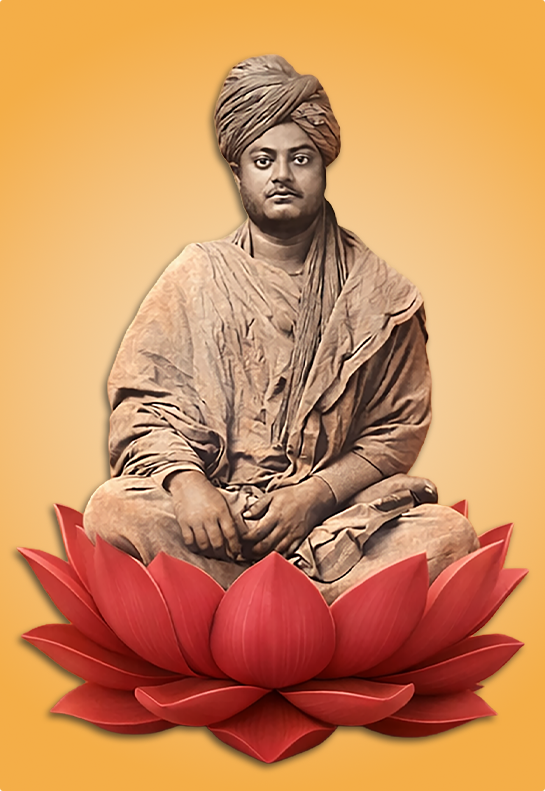
Vivekananda had special faith in the youth. He called upon young people to be strong, fearless, and to dedicate themselves to the service of humanity. He said, "My faith is in the younger generation, the modern generation, out of them will come my workers. They will work out the whole problem, like lions."
He urged youth to develop both physical and mental strength: "You will be nearer to Heaven through football than through the study of the Gita. These are bold words, but I have to say them, for I love you. I know where the shoe pinches." He wanted young people to have "muscles of iron and nerves of steel, inside which dwells a mind of the same material as that of which the thunderbolt is made."
His message was one of hope and empowerment: "Arise, awake, and stop not till the goal is reached." This call to action continues to inspire young people worldwide to realize their highest potential and serve society with dedication and purpose.
Daily inspiration from his timeless teachings
Loading quote...
Deepen your understanding through our library, lectures, and study programs